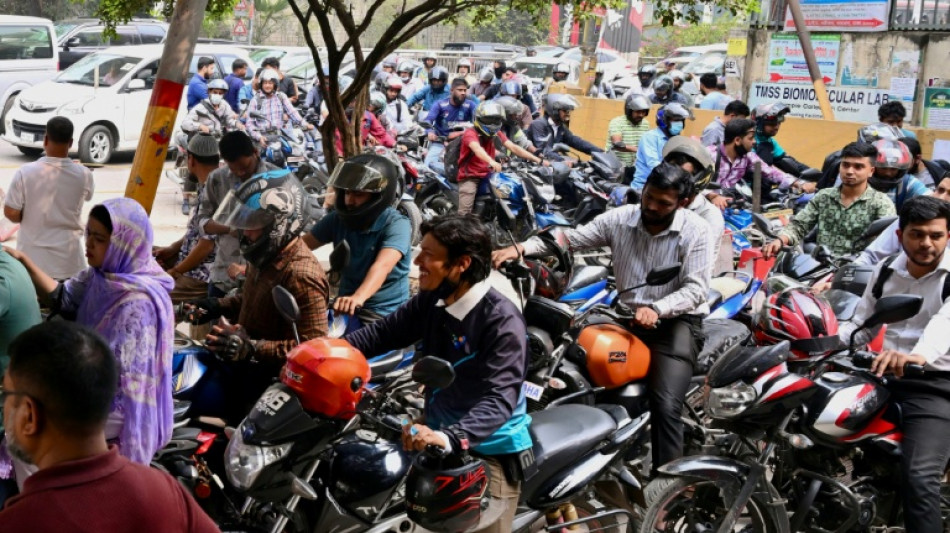
Back to work for Bangladesh migrants as Mideast war grinds on / Photo: MUNIR UZ ZAMAN - AFP/File
Tens of thousands have fled the Gulf to escape the Middle East war, but Bangladeshi migrant workers say they have little choice but to return to earn a living.
At Dhaka airport, lines of workers hugged family members and said tearful goodbyes before boarding flights back to their jobs abroad.
"It's natural to be scared, to feel sad as I am going back," said Mohammed Sakib, 28, flying to Saudi Arabia, leaving his new wife and extended family behind.
"Who knows what might happen?"
Sakib, who has worked in Saudi Arabia for four years as a cleaner, was home for his wedding when war began.
His brother Monirul Islam, 26, embraced him as he left.
"My mother is crying nonstop, so is my sister-in-law," Islam said.
"He is a victim of the situation. He must go back to survive and secure a better future."
Safia Khatun embraced her 24-year-old son Sajjad, who was travelling to the Middle East for the first time, to work in a hospital in Saudi Arabia. Her other son is in Kuwait.
"Boys must go abroad," she said. "What else could he do here?"
Around seven million Bangladeshis work overseas -- the majority in the Middle East, with Saudi Arabia hosting around two-thirds of the total.
Many continue their work as normal, but the shadow of the war looms large.
- 'Absence' -
Syed Ariful Islam, proprietor of Rahman Tours and Travels Agency, said thousands of workers were waiting to return to the Gulf, with flights slowly restarting to some airports.
"More than 400 flights were cancelled, and each flight had the capacity of around 300 or more passengers," he said.
"Now that some flights have partially resumed, expatriate workers have started taking the flights."
Bangladesh's Ministry of Expatriates’ Welfare has said they are "constantly in touch" with nations hosting citizens.
Mizanur Rahman, speaking to AFP via telephone, described how his brother Mosharraf Hossain was killed on March 8 in an airstrike on Al-Kharj in Saudi Arabia, where US forces have a base.
Rahman described his brother's last telephone call, an hour before the missile strike, where he offered gifts for the family at the end of the Muslim holy month of Ramadan.
"He told my nephew to buy a pair of new shoes and clothes for Eid, and promised to call his wife again after breaking the fast," he said.
Now the family have to find a way to pay back the remainder of the loan his late brother had taken out to pay brokers to find work abroad in the first place.
"Everyone is trying to reassure my brother's family," he added. "But I don't know how they will manage in his absence."
V.Bertemes--LiLuX