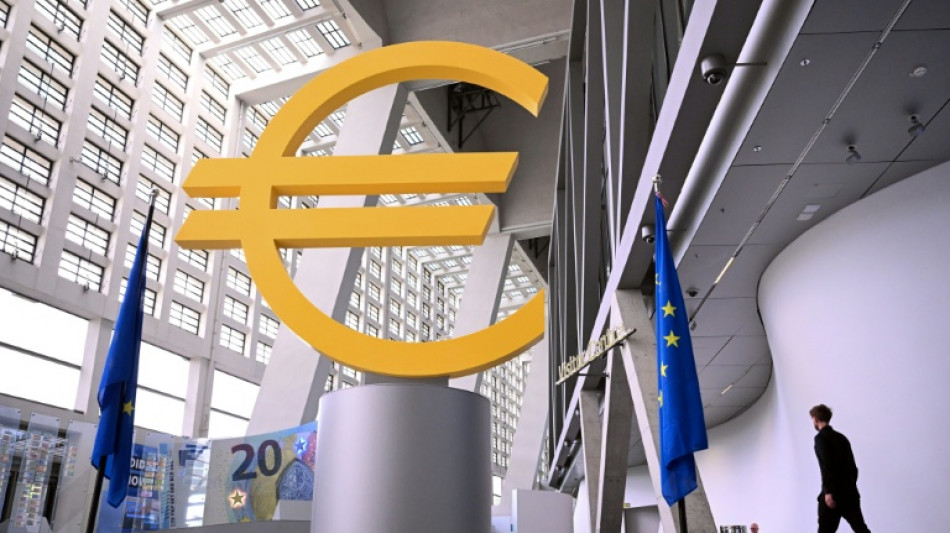
ECB set to hike interest rates as Iran war flares anew / Photo: Kirill KUDRYAVTSEV - AFP
The European Central Bank is expected to raise interest rates again this week as renewed fighting in the Middle East pushes up energy costs and risks further stoking inflation.
Some of the heaviest clashes in weeks in the US-Iran war erupted in recent days, sending oil prices soaring and dimming hopes that energy flows through the Strait of Hormuz will return to normal anytime soon.
Inflation in the 21-nation eurozone, which is heavily dependent on energy imports, hit a three-year high of 3.3 percent in August, substantially above the ECB's two-percent target.
And with fears growing prices will spiral even higher, the central bank is set to hike its benchmark rate for the second time this year when it meets Thursday.
"The ECB governing council looks certain to raise its deposit rate from 2.25 percent to 2.5 percent," said Andrew Kenningham, chief Europe economist at Capital Economics.
The ECB in June delivered its first hike since 2023 to tame surging prices, but then hit pause at its last meeting in July to see how the conflict would develop.
But with Tehran and Washington now seemingly at an impasse, Isabel Schnabel and Joachim Nagel -- both members of the ECB's rate-setting governing council -- have signalled in recent days policymakers will resume hiking rates.
The eurozone economy has also proved resilient, growing faster than expected in the second quarter, leaving policymakers with some room to lift borrowing costs without inflicting major damage.
- 'Many uncertainties' -
The ECB will be armed with fresh growth and inflation forecasts for the next few years to guide its decision, although analysts don't expect major changes to the projections.
Despite rising inflation, some economists nevertheless believe a rate hike is not the right decision.
"We consider another hike a mistake because there is almost no evidence of knock-on effects," Felix Schmidt, senior economist at Berenberg bank, told AFP.
"You can't tackle a supply shock with tighter monetary policy."
The surge in prices has been almost exclusively driven by energy, and there has been little sign of inflation seeping more broadly into other areas of the economy.
While higher borrowing costs typically help tackle inflation by depressing demand in an economy, observers argue it won't do much to blunt the impacts of the current oil supply shock.
For Schmidt, the ECB is simply "very worried about being behind the curve because of the experiences of 2021-2022".
At that time, the central bank faced criticism for moving too slowly as eurozone inflation surged on the back of post-Covid pandemic supply chain woes and then the energy shock from Russia's invasion of Ukraine.
However, most analysts expect the ECB to pause its hikes after this week's meeting.
ECB President Christine Lagarde is, as usual, expected to give little away at her press conference after the rate call and insist that future decisions will be based on incoming data.
ECB council member Nagel, also the head of the German central bank, echoed this cautious stance, saying this week he was "reluctant" to give guidance on future decisions.
"Oil and gas prices keep going up and down. Financial markets are highly volatile. There are many uncertainties," he told France's Le Monde newspaper.
"It is an uncomfortable situation -- also from a monetary policy perspective. But our meeting-by-meeting approach has served us well in the past and will certainly do so in the future."
J.Kayser--LiLuX