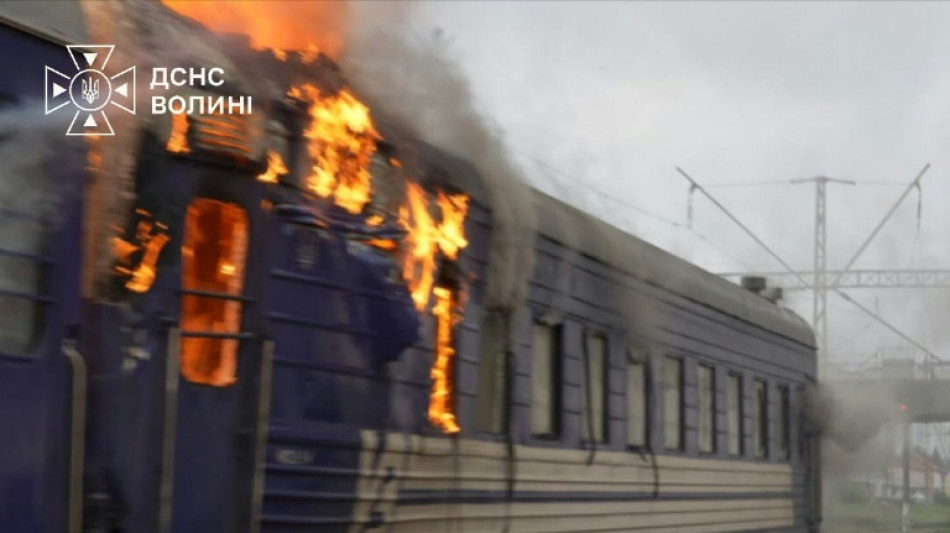
Russian attacks on Ukraine railways escalating every week: rail CEO to AFP / Photo: Handout - Ukrainian State Emergency Service/AFP
Russian strikes on Ukraine's rail network are worsening every week, the CEO of the state operator told AFP on Monday, after one attack hit a train used by diplomats near the Polish border.
President Volodymyr Zelensky has accused Russia of trying to "cripple the economy and destroy people's lives" with intensifying strikes on civilian infrastructure, including the railways.
Ukraine's air space has been closed since Russia launched its invasion. And the railway has become a crucial link in moving people -- including visiting foreign leaders, diplomats and aid workers -- as well as cargo and supplies for the war.
"A virtually continuous campaign of strikes against the railway has begun," Ukrainian Railways boss Oleksandr Pertsovsky told AFP.
"It's growing exponentially. Each month, each week is generally worse than the previous one."
NATO-member Poland said on Sunday that Russia had hit a railway locomotive inside Ukraine, about two kilometres (one mile) from their shared border, just days after Kyiv officials said road crossing checkpoints on the border with Moldova had been targeted.
In August alone, some 40 locomotives were attacked across Ukraine, Pertsovsky told AFP in a telephone interview.
Around 400 have been hit throughout the war in total.
Russia has started hitting parts of the network -- in the west, far from the front line, and the weekend attack on the train near the Polish border -- was a new escalation, he said.
The attack, he said, was the closest one yet to the European Union border.
"They're trying to keep testing everyone's nerves ... The signal is that there is no safe zone on Ukrainian territory," Pertsovsky said.
Asked about the strike, Kremlin spokesman Dmitry Peskov said Monday that Russia would carry on striking targets across the "whole" of Ukraine.
- 'Distressing' evacuations -
Ukrainian trains are halted and evacuated when there is a heightened threat of attack, with passengers standing in fields and forests alongside the track for hours until the danger passes.
In the weekend attack, the train was evacuated just before the strike and nobody was wounded.
Passenger Karina Okhrimenko, 21, told AFP she had already been through two evacuations and finds them "very distressing".
The train is the only means of transport that allows her to see her family in Ukraine.
As she crossed the border, Anna Klymenko, a dermatologist in Kyiv, saw the locomotive that Russia had destroyed the day before.
"They’ve been striking trains for a long time already. It’s just that this time, they decided to target in a more demonstrative way a train that was going abroad," she said.
"I think it was a direct message, aimed mainly at European leaders."
Pertsovsky said the Russian threat was growing. "Their ability to strike precisely at rolling stock and similar targets is clearly expanding," he said.
"Everyone has the feeling that their technical capabilities are growing in terms of autonomy, in terms of overcoming electronic warfare systems, and in terms of the distance at which they can fire."
Sixty-two railway workers have been killed while on duty in Russian strikes since the start of the invasion.
Kyiv says the strikes are just one part of a campaign targeting Ukraine's economy.
The escalating attacks on railways come after months of strikes on Black Sea shipping and alongside attacks on warehouses, agriculture, transport hubs and logistics centres around Kyiv and across the country.
"On the one hand it's about the economy -- this whole complex of strikes against us, our customers, the metallurgical sector, the ports, the infrastructure," said Pertsovsky.
"And on the other hand it's about breaking people's spirit: planting the idea that they've been forgotten, that transport links are being cut off, that they are no longer part of a larger country."
A.Meyers--LiLuX