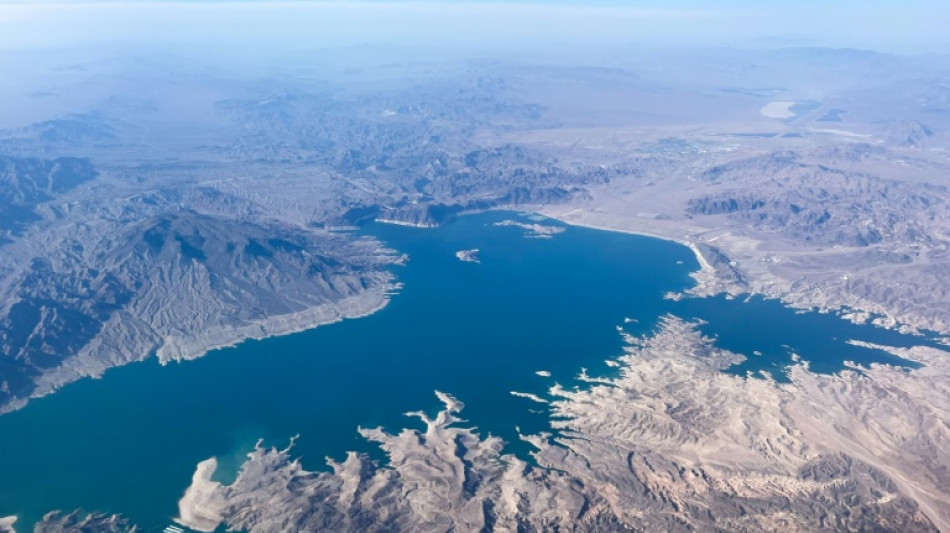
Two largest US reservoirs hit record lows amid western drought / Photo: Eva Claire HAMBACH - AFP
The two largest reservoirs in the United States have fallen to record lows as a severe drought grips the country's West, according to data released over the weekend.
The new records highlight the difficulties fueled by climate change facing the Colorado River, a crucial resource for 40 million people.
The river feeds both Lake Powell and Lake Mead, two reservoirs created by massive dams built to distribute water year-round and generate electricity.
Their water levels are now just above the threshold at which electricity production would be affected.
On Sunday, the level of Lake Powell, which lies mostly in Utah, fell to 3,519.80 feet (1,072.8 meters) above sea level, just below its previous low set in 2023, according to data from the Bureau of Reclamation, the federal agency responsible for monitoring the Colorado River.
On Friday, Lake Mead, created by the Hoover Dam on the boundary between Nevada and Arizona, fell to 1,039.70 feet above sea level, (316.9 meters), data showed.
The seven states that depend on the Colorado River have been arguing for years about how to share the river's water without being able to reach an agreement.
The impasse forced the Trump administration to act as arbiter, unveiling a plan at the end of July that includes significant restrictions to address the drought threatening the river.
The new plan allows the administration to impose restrictions on California, Arizona and Nevada, requiring them to reduce their collective water consumption by up to 3.7 billion cubic meters per year until 2036 -- the equivalent of 1.5 million Olympic-sized swimming pools.
It does not require major efforts from Colorado, Utah, Wyoming, and New Mexico, the other states that depend on the river.
This disputed imbalance could lead to a legal battle, and Arizona has already set aside several million dollars for potential lawsuits.
P.Braun--LiLuX