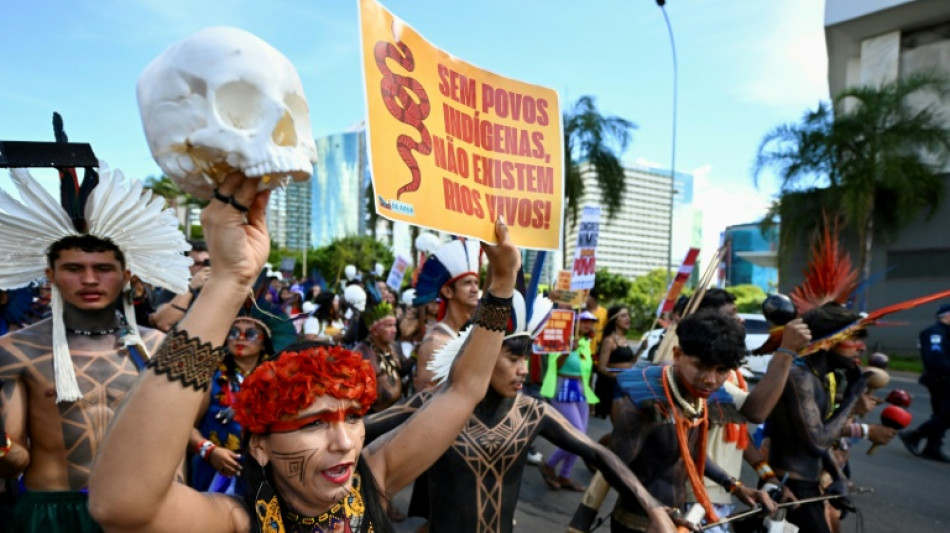
Indigenous groups demand greater land protection in Brazil protest / Photo: Evaristo Sa - AFP
Indigenous protesters from across Brazil marched to the capital Brasilia Tuesday to demand the government expedite recognition of their ancestral lands.
The protest, featuring tribal members in colorful traditional feathers and body decorations, came six months before leftist President Luiz Inacio Lula da Silva, popularly known as Lula, faces a reelection battle.
Indigenous Brazilian peoples broadly supported Lula in 2022 when he defeated his far-right predecessor, Jair Bolsonaro, whose government ceased to recognize native lands and fueled deforestation in the Amazon.
Lula made an important symbolic gesture by naming a respected figure from the Guajajara-Tenetehara ethnicity, Sonia Guajajara, as the head of the new Ministry of Indigenous Peoples.
Lula's government has overseen a drop in Amazon deforestation -- promising to eradicate the felling of trees by 2030 -- and the recognition of 20 territories for the exclusive use of Indigenous communities.
But for some, the new measures are not enough.
"Our principal demand continues to be the formal recognition of Indigenous territories," Toya Manchineri, from the Coordinator of Indigenous Organizations of the Amazon, told AFP.
Experts see the Indigenous reserves as a way to help fight climate change and preserve biodiversity.
As Latin America's largest country, Brazil has 1.7 million Indigenous people out of a population of 212 million.
- 'Enemy' Congress -
The Indigenous groups will camp out in Brasilia until Friday, and plan to dance, play music, host artisan markets and debate.
Thousands marched to Congress on Tuesday, where the Association of Brazilian Indigenous People (APIB) accused lawmakers of being the "enemies of the people" for their alliance with the powerful agribusiness sector -- one of the main drivers of deforestation.
The majority-conservative Congress approved a law in 2023 that limits Indigenous people's land rights. This was later struck down by the Supreme Court, but right-wing parties are working for new restrictions.
The legal limbo leaves Indigenous areas exposed to the penetration of agribusiness and mining interests, Manchineri said. "The impact is huge."
According to the APIB, a hundred Indigenous territories are awaiting the formal signoff of government recognition.
Despite slow progress, native groups will still "cast their votes for the reelection" of Lula, Manchineri predicts.
Although she demanded "justice and resources" for her community, Marilene Gervasio, from the Bare people, said she hoped the leftist will be reelected.
Lula will face Senator Flavio Bolsonaro, the son of the far-right ex-president, in the October election. The most recent polls show a close second round between them.
M.Kieffer--LiLuX