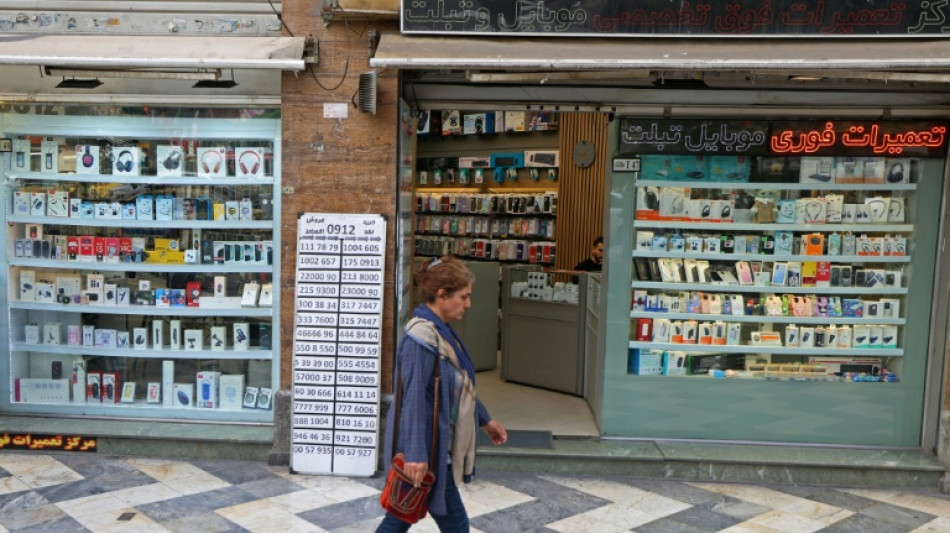
Iran entrepreneurs angered by months-long internet blackout / Photo: ATTA KENARE - AFP
Mahla, an interior designer in Tehran, says she has been forced to sell her valuables and gold to pay employees as Iran's internet shutdown, imposed at the start of the Middle East war, tanks her business.
The internet blackout, which was put in place soon after the US and Israel attacked Iran on February 28, was already the longest nationwide shutdown on record as of April 5, according to NetBlocks, which says it has now lasted more than 50 days.
Iran's highly restricted local intranet has been working throughout the war, allowing people to connect to domestic websites, but it's insufficient for normal businesses in a country already crippled by international sanctions.
Entrepreneurs like Mahla, 55, have been deprived of "proper access to artificial intelligence tools, Google or even emails", she said.
During the war and since anti-government protests in January, during which the internet was also shut down, "the situation has remained unstable," said the woman, who now only has one employee.
The restrictions are taking a toll on business owners' morale.
"Many people can no longer work. They feel exhausted, overwhelmed and hopeless," she said, angry at those "taking advantage of the situation to sell fake VPNs and scam people".
Even before the blackout, access in Iran was heavily filtered, with many social media platforms blocked, requiring the use of VPN software to bypass restrictions.
Mahdi, a 49-year-old accountant in Tehran, said the job situation that was already bad had only gotten worse.
"To find work, you need internet access, but it's not working. And the job postings on websites aren't being updated," he said.
- Millions a day -
Key economic indicators are not always available in a country where all communication is tightly controlled.
But the internet shutdown has clearly "inflicted considerable damage on the digital economy", the US-based Human Rights Activists News Agency (HRANA) said this week on X.
Telecommunications Minister Sattar Hashemi estimated the losses at $35 million per day.
These figures were backed up by fact-checking website Fact Nameh, which published excerpts from an April 13 speech by Afshin Kolahi, head of IT and energy company Rahnama.
The chief executive estimated a direct impact of $30 to $40 million per day from the blackout.
"We are losing the equivalent of two medium-sized power plants per day, and it's our fault," he said.
Entrepreneurs abroad who have staff in Iran are also feeling the impact.
Maryam, 38, owner of a Paris-based online company that employs three people in Tehran, said her orders have fallen.
"In the last two months, we've only received 10 orders, just four of which came after the ceasefire," she said, adding the business would usually get three or four orders a day.
"We have a .com website as well as Telegram, WhatsApp, and Instagram, and none of these services are easily accessible," she added.
"I can't even communicate with my employees because I don't want to use Iranian internal applications for security reasons. I've practically lost contact with the people I work with since the first week of the war."
From time to time, rumours circulate about a partial, or even complete, return of the internet.
But even after the wave of protests in January, it was only partially restored before being completely cut off again with the outbreak of the war.
Hope is fading that the internet will be restored, even as diplomatic efforts between Washington and Tehran carry on.
Amir, 40, said he didn't believe the internet would ever return to the country, his anger at the Islamic republic's leaders growing by the day.
"Even today, they announced that conditions were not favourable for restoring the connection," he told AFP on Friday.
But "they never say it's our right, only that (the outage) is bad for the economy!"
P.Weber--LiLuX