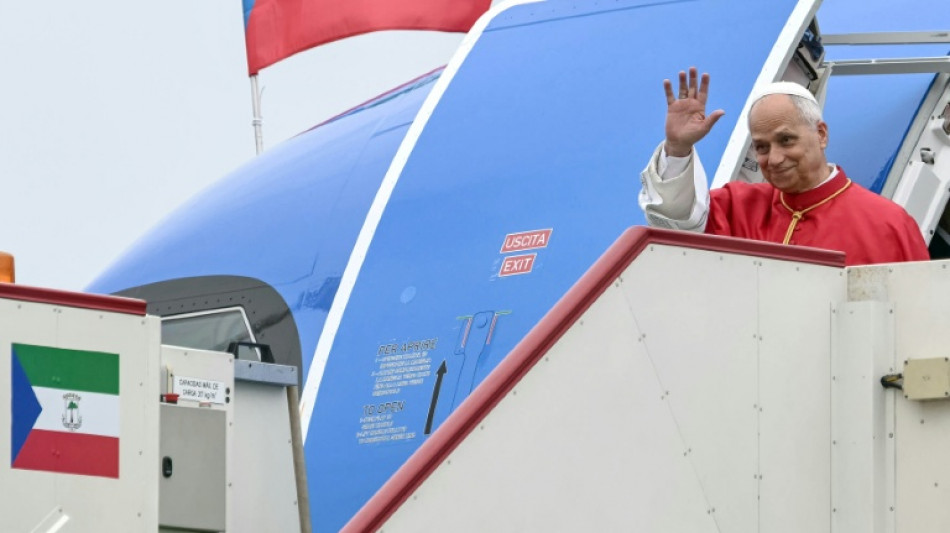
Pope visits Equatorial Guinea on last stop of Africa tour / Photo: Alberto PIZZOLI - AFP
Pope Leo XIV on Tuesday arrived in Equatorial Guinea for the final leg of his African tour, where his increasingly vocal defences of human rights will be closely watched in one of the most closed-off states on the continent.
The central African country has been ruled since 1979 by Teodoro Obiang Nguema Mbasogo, who at 83 is the world's longest-serving head of state who is not a monarch.
A brass band played as the US-born pontiff stepped off the plane and walked down a red carpet alongside the president, as hundreds of worshippers, many wearing t-shirts bearing the pope's image, sang religious songs and vuvuzelas blared.
"The pope's visit to Equatorial Guinea is a grace and a great blessing. I would like the pope to pray especially for young people," Ana-Marie Sofina, 55, told AFP.
During the flight from Angola, where he spent three days, the leader of the world's Catholics paid tribute to his predecessor, Pope Francis, exactly a year to the day since his death.
Leo's visit follows in the footsteps of John Paul II, who 40 years ago became the first pope to visit Equatorial Guinea, an oil-rich country of two million people, 80 percent of whom are Catholic, a legacy of Spanish colonisation.
Throughout his African tour, which began on April 13, the pope has criticised tyranny and exploitation while promoting peace and social justice, swapping his previously reserved style for a tougher tone.
All eyes are on whether that trend will continue in Equatorial Guinea, where he will be hosted by a government regularly accused of authoritarianism and human rights abuses.
Most of the country's opposition figures and independent media, hounded by the authorities, are in exile in Spain.
"The pope is coming for the country's leaders. His visit won't do anything for us, because he's not coming to persuade the ruling class to take our suffering and grievances into account at the expense of their own enrichment with the country's resources," said Anita Oye, a tomato seller in the former capital Malabo.
The majority of the population remains poor despite one of the highest per capita incomes in Africa, due in particular to oil revenues.
The Equatorial Guinean authorities are regularly singled out by international NGOs for endemic corruption and repression of the opposition, marked by arbitrary detentions and curbs on public freedoms.
- 'Spiritual change' -
In Malabo, located on the island of Bioko in the Gulf of Guinea, giant portraits of the pope and welcome banners line the streets, alongside flags of the Vatican and Equatorial Guinea.
A hymn composed in his honour will be sung by church choirs across the country throughout his visit.
Malabo resident Juan Raul told AFP he sees the visit as an opportunity to bring the nation together.
"This will bring spiritual change and motivate many people to go to mass," he said.
But some fear that the country's people will have to foot the bill for the pope's visit, including Andres Esono Ondo, who heads the country's only approved opposition party, the Convergence for Social Democracy.
Ondo feared that the trip would cause even more suffering among a population forced to bear "the economic damage", which he assumed was "something the pope does not wish for".
Leo will speak on Tuesday before the president, members of the government, the diplomatic corps and civil society, as well as representatives of the cultural sector.
On Wednesday, he will travel to Obiang's Mongomo stronghold to hold a mass and greet students and teachers at a technology school named after Pope Francis.
He will then continue to the economic capital Bata to pay tribute to the victims of a 2021 explosion that killed more than 108 people in a military camp and also visit inmates at Bata prison.
On Thursday, the pontiff will hold a large mass at Malabo stadium before wrapping up his whirlwind 11-day 18,000-kilometre (11,200-mile) journey across Africa.
P.Ries--LiLuX