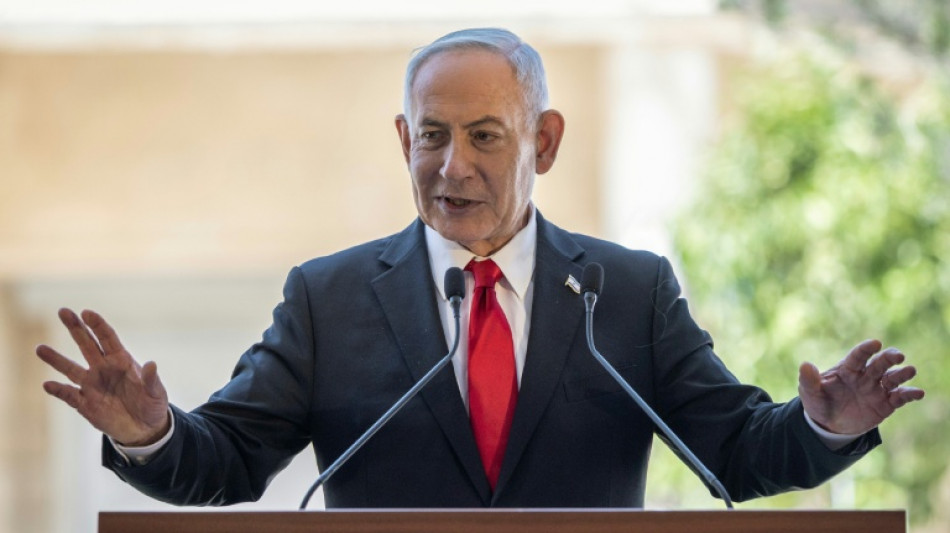
Israel elections to be held on October 27: parliament / Photo: ilia YEFIMOVICH - AFP
Israel will hold national elections on October 27, the last date allowed by law, its parliament said on Sunday, with the vote widely seen as a referendum on Prime Minister Benjamin Netanyahu's leadership since the Gaza war erupted.
The Knesset, as parliament is known, is set to end its current term on July 17, allowing the ruling coalition to complete a full four-year term for the first time in decades.
"Since the current Knesset is expected to serve its full term and the next general election is already set by law for October 27, with no intention of shortening the legislature's tenure, there is no need to enact a Knesset Dissolution Law in the usual sense," parliament said in a statement.
Netanyahu, 76, is already the country's longest-serving prime minister, having served multiple, non-consecutive terms, and has declared his intention to run again.
He has said he "intends to win" the election, setting the stage for what could be the defining contest of his political life.
In recent days, his government -- one of the most right-wing coalitions in Israel's history -- has been racing to pass a series of bills in a bid to shore up his alliance and enter the election from a position of strength.
Last month, Netanyahu even said that he intended to "establish a broad national government, not a right-wing, not a left-wing government that depends on Arab parties, but a broad national government".
By reaching across the aisle, Netanyahu appears to be trying to reframe his electoral pitch around national unity rather than ideological alignment.
But recent polls show that a majority of Israelis want him out of office, with former military chief Gadi Eisenkot emerging as his main rival.
- Key issues -
A recent poll by the Hebrew University of Jerusalem found that more than 92 percent of Israelis believe Iran had won the Middle East war, and support for Netanyahu's premiership plummeted from 40.5 percent in early March to 29.4 percent in June.
Public opinion turned critical of the ceasefire that halted the war Israel and the US launched against Iran in late February, which led to a deal between Tehran and Washington that many view as unfavourable to Israel.
Anger also lingers over the security failures surrounding the October 7 attacks, which continues to weigh on Netanyahu's standing.
Voter sentiment is expected to be affected by a bitter dispute over whether ultra-Orthodox Jewish men should serve in the military.
Netanyahu's key allies had repeatedly threatened to topple the current government unless their constituents were exempted from the draft, while the Israeli military and much of the public argue that broad enlistment is necessary, after years of wars have left the armed forces stretched thin.
The other flashpoints are judicial reforms that he initiated before the Gaza war erupted, his own ongoing corruption trials and uncertainty over Gaza's post-war governance.
The wars against Hezbollah and Iran have created a politically complicated backdrop for Netanyahu.
He said, however, that the government he envisaged forming after elections would help complete Israel's regional ambitions.
"After we have removed the Iranian existential threat, the broad national government can make peace within ourselves, deal with the remnants of the Iranian axis and reap the fruits of our victory in political agreements like the one we are making with Lebanon -- and there are a few more on the way," he said.
Netanyahu's remarks suggest he intends to use Israel's military campaign against Iran and Lebanese militant group Hezbollah as the centrepiece of his election narrative, pivoting from a fragile ideological coalition to a broader, security-anchored governing mandate.
D.Rueter--LiLuX