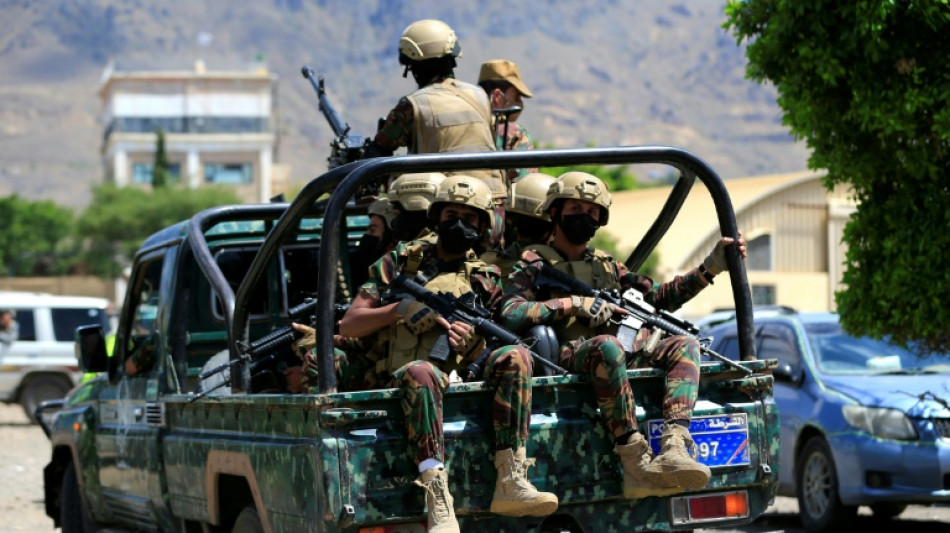
Houthis say hit Saudi base after renewed fighting with Yemeni govt forces / Photo: Mohammed HUWAIS - AFP
Houthi fighters on Sunday said they used drones and missiles to attack a military base in southern Saudi Arabia as renewed fighting with Yemen's government forces forced growing numbers of civilians to flee.
The attack at the southern Sharurah base targeted "weapons depots and command and control centres that are managing the aggression against our nation and people", Houthi military spokesman Yahya Saree wrote on X.
The date of the operation was not specified. Clashes have increased this week between the Iran-allied Houthis and Yemeni government forces, which are backed by Riyadh.
On Saturday, the government forces said they had struck Houthi fighters in the Red Sea city of Mocha, and later attacked other Houthi positions in the southwestern part of the country.
"Air Force of the Armed Forces targeted positions and barracks of the terrorist Houthi group with three airstrikes" in the Taiz region, the Yemeni military said Sunday in a post on X.
US news site Axios also reported that Saudi Crown Prince Mohammed Bin Salman twice called US President Donald Trump to request strikes on the Houthis last week, but that the request was rejected.
The ongoing clashes follow a week-long Houthi offensive that culminated in the group capturing the remainder of Yemen's Red Sea coast and several strategic islands, cementing their hold on the Bab al-Mandab Strait at the sea's southern entrance.
The waterway has become an important artery for Saudi Arabian oil exports after Iran largely cut off shipments through the Gulf with its blockade on the Strait of Hormuz at the start of the Middle East war.
The Houthis have recently declared their own maritime blockade of Riyadh's Red Sea ports.
The government news agency Saba reported on Saturday that Yemeni "forces destroyed vehicles and weapons and killed members of the Houthi terrorist militia" near the port of Mocha, and quoted a spokesman for the forces as saying they had also struck Houthi targets just outside the city.
The Houthis, meanwhile, said on Saturday evening that over the past 48 hours, "Saudi enemy aircraft conducted 129 airstrikes" on areas under their control.
- 'Not even a shelter' -
Yemen's civil war, which began in 2014 with the Houthi capture of the capital Sanaa, had been dormant since a ceasefire in 2022 but roared back to life in July.
Saudi Arabia first entered the war on the side of Yemen's internationally recognised government in 2015 and continues to support the Aden-based administration.
On Saturday night, Saudi authorities said a Houthi projectile fell in an area near the border, hours after issuing alerts warning of the risk of possible attacks.
The civil defence directorate said the incident resulted "in two injuries and material damage to a mosque, several buildings, and vehicles".
The Yemeni civil war has uprooted millions of people, and the latest fighting has led even more to flee their homes.
The fall of Mocha to the Houthis on Thursday drove many residents to Aden, where the internationally recognised government is based.
One of the displaced, Abdulali al-Rajihi, said the Houthis "told us: 'Leave, scatter, you have half an hour'".
"We fled wearing the clothes on our backs. And we took our children, as much as we could manage."
Saddam Ali escaped from Al-Waziyah with his 11 children and a few possessions crammed into a small pick-up truck. He said he hadn't found a single free house in the city, "not even a shelter".
The UN's migration agency said on Saturday that, since July, 76,000 people had fled the fighting, a figure that had quadrupled since last week.
About 1,400 people had fled to Djibouti, the country's minister of economy and finance Ilyas Moussa Dawaleh said on Saturday.
The renewed fighting in Yemen has killed more than 500 people, according to sources on both sides.
- 'Fine and dandy' -
Trump on Saturday acknowledged speaking to the de facto Saudi leader but said the Houthis had also "called us and they don't want to fight with us".
He did not elaborate on whether Washington would take any action, but told reporters that "everything's gonna work out fine and dandy" in the region.
In 2025, the United States conducted a seven-week bombing campaign against the Houthis in response to their repeated attacks on Red Sea shipping in support of Hamas in the Gaza war.
That ended with a negotiated ceasefire, though the Houthis kept up their missile and drone attacks targeting Israel.
More recently, the group has resumed attacks on ships in the Red Sea after declaring their maritime blockade of Saudi Arabia.
In Yemen's capital Sanaa, Houthi supporters celebrated the freeing of 210 prisoners held in areas that fell to the group and had spent up to eight years in jail.
H.Wagner--LiLuX