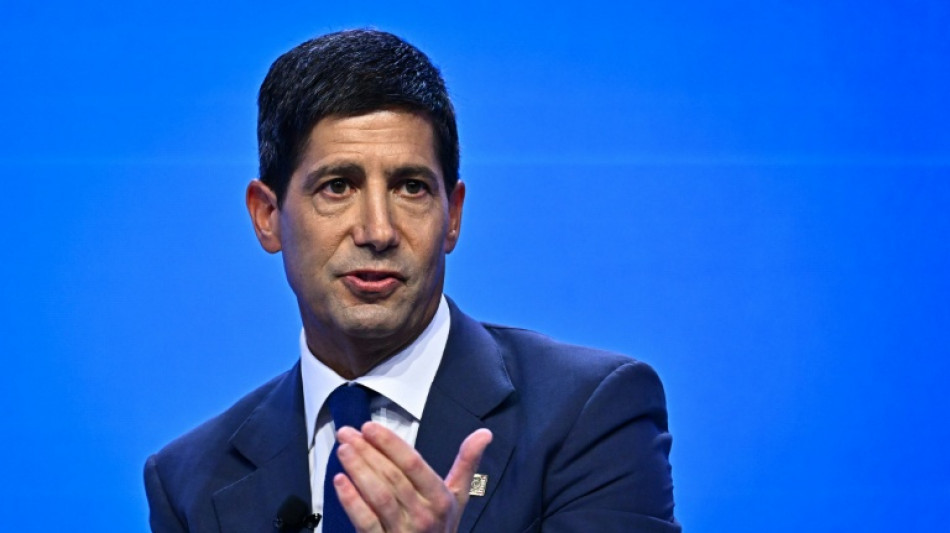
Fed expected to hold rates steady days ahead of US midterms / Photo: Lillian SUWANRUMPHA - AFP/File
The US Federal Reserve appears set to hold interest rates steady at its meeting next week, analysts say, despite stubbornly high inflation and with markets pricing in at least one rate hike before year-end.
The central bank's Federal Open Market Committee (FOMC) will meet over two days, announcing its decision at 2:00 pm local time (18:00 GMT) on Wednesday.
The Fed has missed its long-term two-percent target for inflation for more than five years, and at its last meeting in September the FOMC voted to raise the key federal funds rate for the first time in three years, lifting the target range to 3.75 percent to 4.0 percent.
The Fed's meeting comes days ahead of key midterm elections in the United States on November 3, with the Democratic Party seeking to wrest control of both houses of Congress from US President Donald Trump's Republicans.
Trump frequently berated and criticized Fed Chair Kevin Warsh's predecessor Jerome Powell over interest rates -- which he deems to be too high -- but has so far refrained from targeting the man he appointed to replace him over the issue.
The Fed's preferred gauge for inflation, the Personal Consumption Expenditures (PCE) price index, hit a pandemic-era peak of 7.2 percent in 2022, before a series of interest-rate hikes tamed it to around 2.2 percent by late 2024.
Trump's economic policies -- including his upending of the global trade order using tariffs and his war on Iran -- fuelled it once more, and it hit a three-year high of 3.9 percent in May.
Since the United States and Israel attacked Iran in late February, global energy prices have skyrocketed, with Tehran's retaliatory actions sharply curtailing oil and gas supplies through the Gulf.
Higher energy prices have begun to cascade through into other goods and services, fuelling inflation in the United States, with prices a key issue for voters as they head to the polls.
- 'Based on the economics' -
Loretta Mester, former regional head of the Cleveland Fed, told AFP that the timing of the meeting just days ahead of the election would not be a factor for policymakers.
"The Fed doesn't take into account any kind of political issues in that FOMC room," she said. "It really is based on the economics."
Mester argued that the fundamentals call for continuing to raise interest rates.
"The data that's come in continue to show a stable labor market and continue to show inflation above target," she said, adding that there was no evidence that it was on a path downwards towards the target.
"The economics would suggest then you need to continue raising rates."
Still, she thought that most policymakers seemed keen to avoid moving too quickly, and may hold rates at this meeting, waiting to tighten the screws until the following meeting in early December.
Wendy Edelberg, a senior fellow at the Brookings Institution, believes central bankers would rather not put themselves in the middle of the political debate ahead of the midterms.
"It's unhelpful for everyone if the Fed gets wrapped up in all the political discourse right before an election," she told AFP.
Edelberg said that "there wouldn't be huge economic implications" if policymakers raised rates in December as opposed to October.
She saw such a decision less as a "nod to Trump" -- who has aggressively demanded lower rates to spur economic activity -- and more a way to avoid being the potential target of political barbs.
Since returning to power last year, the US president has waged an unprecedented assault on the Fed's independence, launching a criminal probe against Powell and attempting to unseat Fed Governor Lisa Cook.
The probe against Powell was dropped to smooth the way for Warsh's Senate confirmation, but the battle to fire Cook continues despite a Supreme Court decision nullifying an earlier attempt to do so.
Last week, Cook declined to attend a hearing in the White House's probe into mortgage fraud allegations, which she denies.
Y.Erpelding--LiLuX